Why Hedging Costs Spike: Compare VIX Call Options
Hedging costs do not rise politely. They gap higher when equity liquidity thins, index options reprice, and the volatility complex stops behaving like a cheap insurance market.
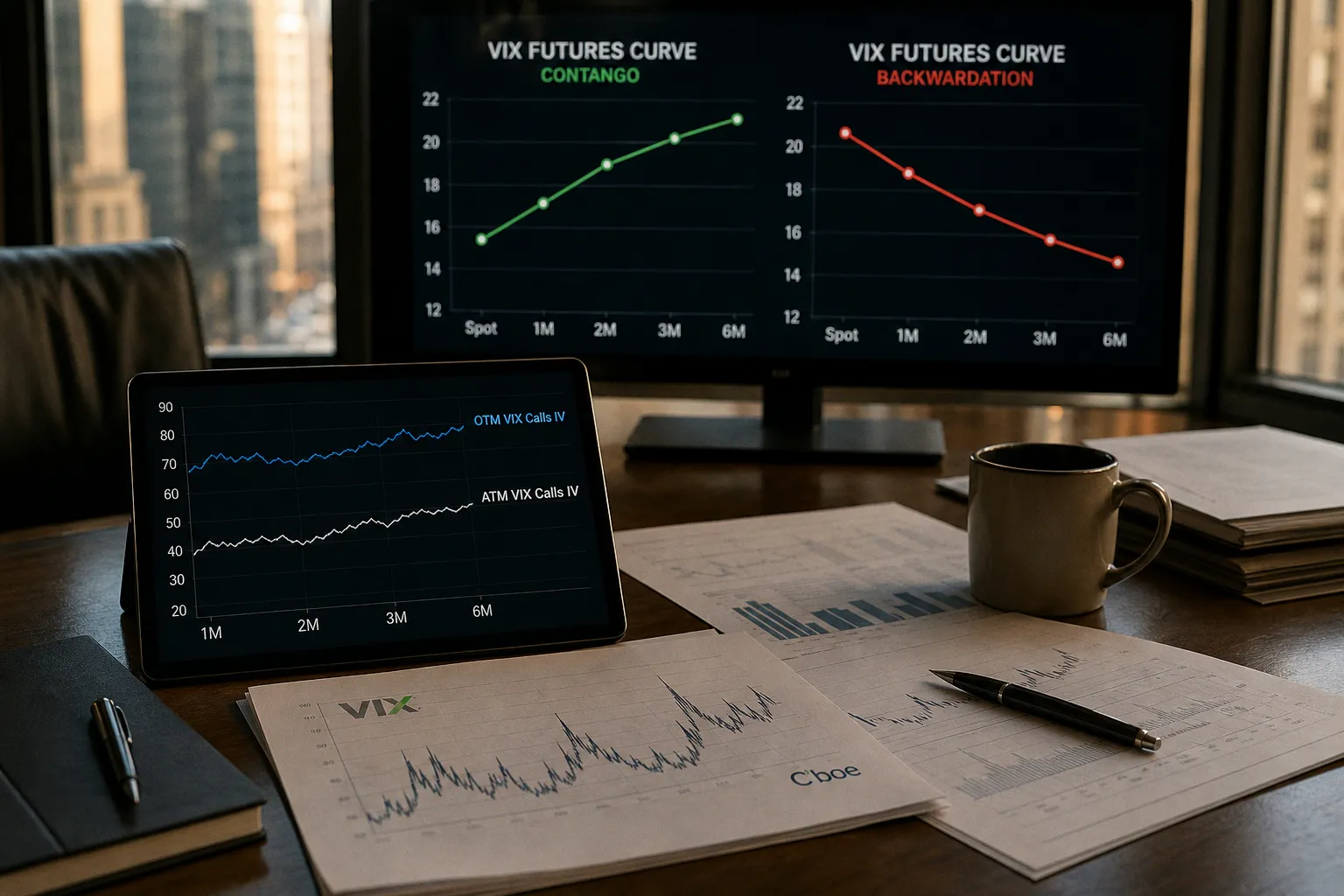
That distinction matters most when the market is already stressed. A portfolio manager looking at the S&P 500 drawdown may see spot VIX moving fast and assume VIX calls offer straightforward convex protection. They do not. The hedge cost depends on the VIX futures curve, the strike, the expiry, implied volatility skew, and the cash-settled European-style mechanics. Misread one of those inputs and you overpay for protection that may not respond when your book needs it.
Decode the VIX Term Structure Before You Compare Any Call
The first comparison is not option premium versus option premium. It is curve regime versus curve regime.
VIX measures the market’s expectation of 30-day volatility derived from S&P 500 index option prices. But VIX options are priced against VIX futures expectations for the relevant expiry, not directly against the spot VIX print on your screen. That means the futures curve controls the practical reference point.
In normal markets, the VIX futures curve often sits in contango: longer-dated futures trade above spot VIX. This reflects the market charging for future uncertainty while near-term stress remains contained. In that regime, a VIX call may look expensive relative to spot VIX because the option is anchored to a future level already above spot.
In stress, the curve can flip into backwardation: near-term volatility trades above deferred volatility. That is the market telling you immediate insurance demand has overwhelmed the curve. Hedging costs usually spike in that transition because the market is repricing urgency, not just volatility.
Use this framework:
| Curve condition | What it signals | Effect on VIX call comparison | Portfolio implication |
|---|---|---|---|
| Contango | Stress is contained or deferred | Calls may price off futures above spot, making “cheap” strikes less cheap than they appear | Avoid comparing premiums to spot VIX alone |
| Flat curve | Uncertainty is rising across expiries | Relative value shifts to strike and expiry selection | Recalibrate hedge tenor; do not extend blindly |
| Backwardation | Immediate market stress | Front-month calls become expensive and crowded | Hedge downside selectively; avoid panic premium |
If you are comparing two VIX calls and only one has a lower dollar premium, that is not enough. Normalize the premium against the relevant VIX future, the strike distance, and time to expiry. A 25-strike call may be meaningfully out-of-the-money against one expiry and much closer to the money against another.
The VIX spot level is a headline. The VIX futures curve is the tradeable terrain.
Investors must note the mechanical friction here. You are not buying the visible fear gauge in isolation. You are buying a derivative on the expected settlement value of that gauge. That is why a call can fail to move as expected even when spot VIX jumps intraday.
Why VIX Options Price off Futures, Not Spot
The common error is simple: spot VIX rises from 14 to 20, and a trader expects every VIX call to reprice in a straight line. That is not how the market works.
VIX itself is not a stock, an ETF, or a deliverable instrument. You cannot take delivery of VIX. VIX options are cash-settled, European-style contracts. Their pricing is tied to the expected VIX settlement value at expiry, which is represented through the VIX futures market.
This creates a basis problem. Spot VIX can jump, but if the move is viewed as temporary, the relevant VIX future may rise less. A call tied to that expiry will respond to the future, not to the full spot move. Conversely, if the market starts pricing persistent stress, futures can reprice sharply across the curve, and call premiums expand faster than a simple spot comparison would suggest.
When comparing VIX calls, work through the chain in order:
1. Identify the option expiry. VIX has weekly and monthly expiration cycles. The settlement timing is not an administrative detail; it defines the volatility window you are trading.
2. Locate the corresponding VIX future. Treat that future as the effective forward reference, not spot VIX.
3. Measure moneyness against the future. A call strike should be judged relative to the futures level for that expiry.
4. Compare implied volatility across strikes. The premium reflects demand for convexity, especially in out-of-the-money calls.
5. Stress-test payout against portfolio loss scenarios. A volatility hedge is only useful if its expected convexity offsets the drawdown path you are trying to control.
This is where practical hedging separates from ticker-watching. If your equity exposure is short-duration and highly sensitive to a near-term index shock, a far-dated VIX call may dilute the response. If your risk is a slower volatility repricing across global stock indexes, a very short-dated call may decay before the stress monetizes.
Do not use VIX calls as a generic anxiety trade. Assign the hedge to a risk window.
Read the Skew: Tail Protection Is Usually the Expensive Part
Implied volatility skew in VIX options carries the market’s price for tail protection. Out-of-the-money VIX calls often trade with higher implied volatility than at-the-money calls because investors crowd into upside convexity when they want protection against sharp equity drawdowns.
That skew is not noise. It is the cost of being late.
A 40-strike VIX call may look optically cheap in premium terms. But if the implied volatility is sharply elevated, you may be paying a high volatility price for a low-probability payout. That can be acceptable for disaster insurance. It is not acceptable if you believe you are buying efficient day-to-day portfolio protection.
Compare calls by implied volatility, not just by premium. The lower-premium option can still be the worse allocation if the strike is too remote or the skew is too punitive.
A practical comparison should separate three types of VIX call exposure:
| Call type | Typical role | Main risk | When it becomes defensible |
|---|---|---|---|
| At-the-money call | Responsive volatility exposure near current futures level | Higher upfront premium | When stress is already building and timing matters |
| Moderately OTM call | Convex hedge with lower premium | Requires a stronger volatility move | When portfolio drawdown risk is material but not immediate |
| Deep OTM call | Tail-risk disaster hedge | High decay and low hit rate | When the mandate requires crash convexity, not routine protection |
The institutional decision is not “which call is cheapest.” The decision is “which call pays under the loss distribution that matters to this portfolio.”
If your book is long high-beta equities, small caps, or crowded momentum exposure, you need to model whether the VIX call responds to the same stress that damages the book. VIX can remain low during some market declines, especially if selling is orderly or concentrated outside S&P 500 index options. Do not assume automatic offset.
The relationship is derivative. VIX reflects expected S&P 500 volatility. It does not track the S&P 500 directly. Treat that as a hard constraint.
Expiration and Settlement Mechanics Change the Hedge
VIX options are European-style. They cannot be exercised early. They settle in cash based on the VIX settlement value. That removes stock-delivery complications, but it adds timing risk.
The monthly VIX options expiration is typically on the Wednesday that is 30 days before the third Friday of the following calendar month. Weekly expirations add flexibility, but they also tighten the clock. A hedge with five trading days left can look efficient until realized stress arrives two sessions late.
You must align expiration with the risk event. If you are hedging an earnings-heavy index period, a central bank decision, or an options-expiration liquidity pocket, the expiry must cover the actual volatility window. If it expires before the event risk clears, the hedge is a decay position, not protection.
Use an if/then structure before allocating capital:
- If the risk is immediate and event-specific, use shorter-dated exposure only if you accept rapid theta decay and settlement timing risk.
- If the risk is a broader volatility regime shift, avoid overconcentrating in the front expiry. Recalibrate across expiries where futures repricing can persist.
- If the curve is already in backwardation, reduce size or use defined budgets. You are buying protection after the market has already marked up urgency.
- If the curve is in contango and skew is moderate, compare call spreads or staggered expiries rather than reaching for deep OTM calls.
- If liquidity is thin, do not rely on mid-market marks. Work limits and assume slippage will widen during the exact condition that makes the hedge valuable.
Settlement also affects monetization. Because there is no early exercise, you manage the option by trading it, not by exercising it. That requires liquidity. In a volatility spike, bid-ask spreads can widen, and theoretical gains may be harder to capture cleanly.
This is why a hedge must include exit rules. A VIX call that triples and then collapses before the portfolio manager acts is not a hedge. It is an unmonetized mark.
Compare Cost Against Portfolio Function, Not Market Fear
Hedging costs spike because the marginal buyer of protection becomes less price-sensitive during stress. That buyer may be a systematic volatility-control fund reducing equity exposure, a macro book covering short volatility, or an institution protecting quarter-end drawdown limits. The mechanism varies, but the result is the same: convexity becomes expensive when everyone wants it.
For capital allocation, compare VIX calls against the job they must perform.
A hedge can serve at least four distinct functions:
1. Drawdown dampener. It should offset equity losses during a sharp S&P 500 volatility shock. Prioritize responsiveness and expiry alignment.
2. Liquidity reserve. It should create gains that can be monetized to rebalance into dislocated assets. Prioritize tradability and realistic exit levels.
3. Tail-risk budget. It should pay only in extreme scenarios. Prioritize low premium outlay but accept a low probability of payout.
4. Volatility regime exposure. It should benefit from a sustained repricing of expected volatility. Prioritize futures curve structure and avoid single-expiry concentration.
These are not interchangeable. A deep OTM call may satisfy a tail-risk budget but fail as a drawdown dampener. An ATM call may respond quickly but consume too much premium if held repeatedly during calm markets. A short-dated call may hedge a known event but fail against a slow macro deterioration.
For broader context, market attention itself often clusters around stress events before positioning data fully reflects it; tracking public search momentum through resources that monitor what is trending today can help frame the information environment, but it should never replace option-chain analysis.
Keep the hierarchy disciplined. Curve first. Futures reference second. Skew third. Settlement and liquidity fourth. Premium last.
Cheap premium is not cheap protection if the strike, expiry, and futures reference do not match the portfolio risk.
A Practical Comparison Workflow
When you compare VIX calls, build a small grid before entering the order. This prevents the classic error of buying the wrong expiry because the premium looks manageable.
Start with the portfolio loss scenario. Define the equity move, volatility response, and timing. Then map the option.
| Input | Required action | Bad shortcut to avoid |
|---|---|---|
| Portfolio risk window | Match expiry to the period when losses can occur | Buying the nearest cheap weekly without event coverage |
| VIX futures level | Measure strike distance against the relevant future | Comparing strike to spot VIX only |
| Curve regime | Adjust size based on contango, flatness, or backwardation | Treating every VIX spike as the same setup |
| Skew | Compare IV across ATM and OTM calls | Assuming low dollar premium means low cost |
| Liquidity | Check bid-ask conditions and order depth | Using theoretical marks during stress |
| Exit rule | Define monetization levels before entry | Waiting for maximum panic |
The output should be a hedge ratio, not a feeling. Decide how much premium the portfolio can spend over a defined period. Then decide how much drawdown offset the hedge must target. If the math does not justify the premium, reduce size, change structure, or do not trade.
VIX calls can be useful. They are also easy to misuse. The product’s appeal is convexity, but convexity is most expensive when it feels most necessary. That is the central problem. You are rarely paid to buy protection emotionally.
In many cases, call spreads can reduce premium outlay by selling a higher strike against the long call. That caps upside, but it may improve cost discipline. The trade-off is clear: you give away extreme tail participation to make the hedge more financeable. For portfolios that need drawdown control rather than catastrophe payout, that may be acceptable. For portfolios with strict crash-risk mandates, it may not.
Do not let structure complexity hide the exposure. A call spread is still a volatility hedge with timing, settlement, and curve risk. A calendar spread adds term-structure risk. A basket of expiries reduces timing concentration but increases management burden. Use only what your process can monitor.
Final Operating Rules
Hedging costs spike because the volatility market reprices immediacy, convexity, and liquidity at the same time. VIX call options sit at the center of that repricing, but they are not simple insurance. They are cash-settled, European-style contracts tied to expected VIX settlement values through the futures curve. Compare them mechanically or do not use them.
Before allocating capital, run this strict parameter check:
- Confirm the VIX futures curve regime: contango, flat, or backwardation.
- Compare strike moneyness against the relevant VIX future, not spot VIX.
- Measure implied volatility skew across ATM, OTM, and deep OTM calls.
- Match expiry to the actual portfolio risk window.
- Account for European-style cash settlement and no early exercise.
- Set premium budget before stress widens the market.
- Define monetization levels in advance.
- Size the hedge to portfolio drawdown risk, not to market headlines.
- Avoid assuming VIX calls will automatically offset every equity decline.
- Recalibrate exposure when curve structure changes.
If those conditions are not clear, stand down or reduce size. The market does not reward vague hedging. It charges for it.