Compare Fed rate hike steps to historical inflation drops
The statistically relevant comparison is not the rate hike on announcement day. It is the federal funds rate path mapped against CPI after a 12–18 month lag.
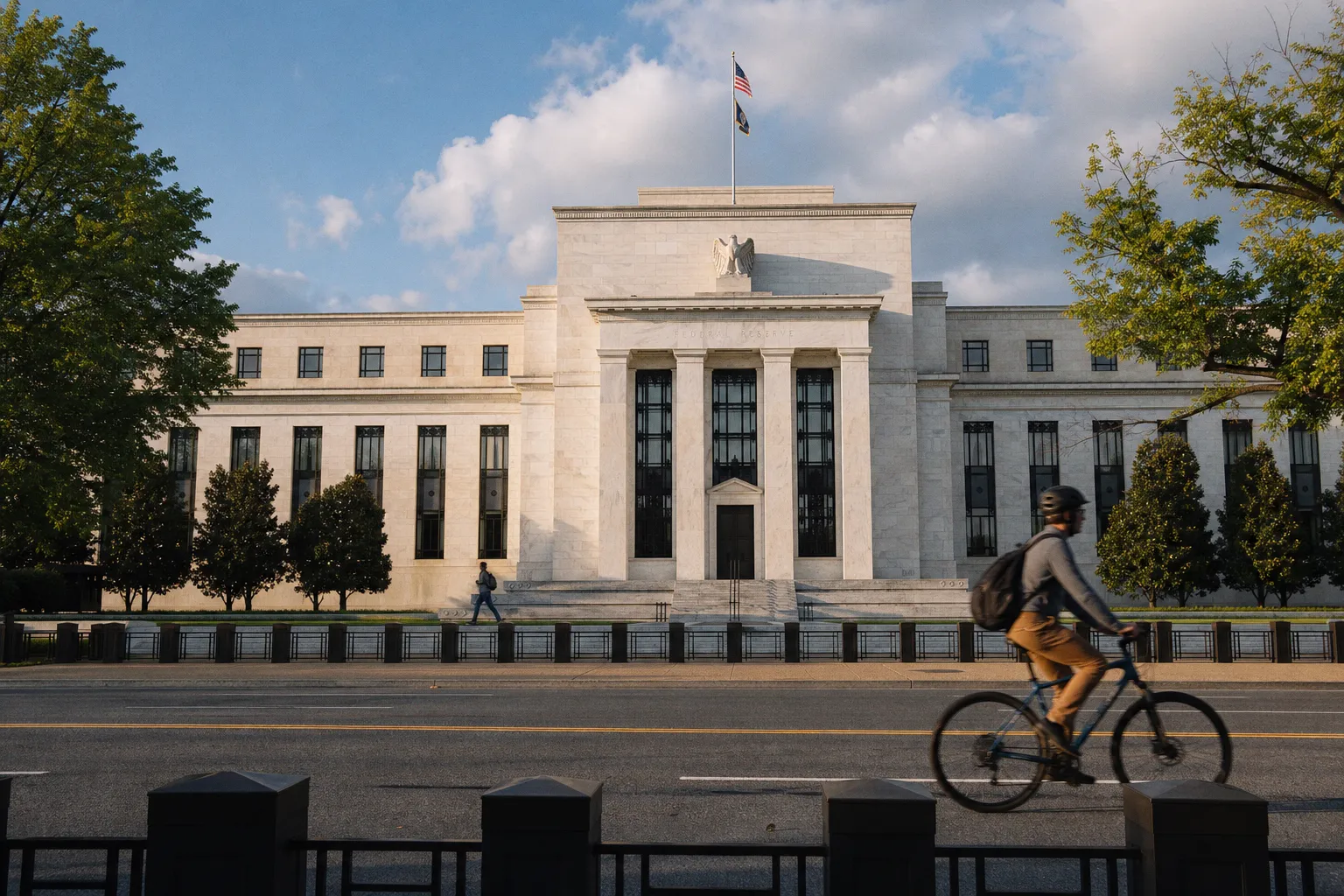
The practical question is therefore narrow: how to check compare Fed rate hike steps to historical inflation without attributing every CPI decline to the last FOMC move. The answer is a lagged, cycle-based comparison. Align the federal funds rate trajectory with year-over-year CPI, isolate the cumulative rate change, classify the hike increments, then test whether inflation deceleration follows inside the expected policy transmission window. Anything shorter is event commentary, not monetary analysis.
The 12–18 month lag is the base unit, not a footnote
Federal Reserve tightening works through price-insensitive channels first and consumer prices later. Treasury yields reprice in minutes. Mortgage rates and credit spreads adjust in days. Loan demand, hiring plans, capital expenditure, and rent resets need quarters. CPI is the final line item, not the first.
Economists commonly estimate full monetary transmission at 12–18 months. That range should be treated as the minimum analytical horizon for comparing rate hike steps to historical inflation drops. A CPI decline two months after a rate decision can be consistent with tighter policy. It is not clean evidence of that policy’s effect. Energy base effects, supply normalization, inventory liquidation, exchange-rate shifts, fiscal drag, and margin compression can all dominate the short window.
A robust comparison uses lag buckets:
| Policy variable | CPI comparison window | Signal quality |
|---|---|---|
| Single 25 bp hike | 0–3 months | Low. Mostly market pricing and coincidence risk |
| Cumulative hikes over one quarter | 6–9 months | Moderate. Credit conditions begin to bind |
| Cumulative hikes over two to four quarters | 12–18 months | Higher. Transmission window aligns with CPI effects |
| Restrictive rate held above neutral | 18+ months | Highest, but contaminated by recession and shock effects |
The lag structure matters because the Fed does not tighten once. It tightens as a path. A 25 bp move at the beginning of a cycle is different from a 25 bp move after 400 basis points of cumulative increases. The same increment has a different marginal effect depending on the level of real rates, the slope of the yield curve, bank balance-sheet capacity, and inflation expectations.
The unit of analysis is not one hike. It is cumulative restriction held through the lag window.
For historical work, the rate variable should be the effective federal funds rate or target range midpoint. The inflation variable should be year-over-year CPI for the broad comparison, with core CPI or core PCE used for a cleaner demand-sensitive read. The primary chart should shift CPI forward by 12 months and 18 months against the funds rate path. That single adjustment removes most false precision.
Calibrating hike intensity: 25 bp, 50 bp, 75 bp
The Federal Reserve typically adjusts the federal funds rate in 25 basis point increments. The 25 bp step is the standard unit because it reduces communication shock, preserves optionality, and allows the Committee to update policy as incoming data changes. Larger steps compress time. They are not just “more tightening.” They are a signal that the reaction function has changed.
The 2022–2023 tightening cycle made 50 bp and 75 bp hikes central again. Those increments were used during an aggressive inflation fight after inflation had moved materially above target and policy was judged to be behind the curve. The larger step size accelerated the move from accommodation toward restriction. It did not eliminate the lag.
A useful comparison separates three dimensions:
1. Step size. The individual FOMC move: 25, 50, or 75 basis points.
2. Pace. The basis points added per quarter.
3. Terminal level. The peak policy rate reached before pause or reversal.
4. Real rate condition. Policy rate adjusted for inflation expectations or realized inflation.
5. Hold period. The time policy remains restrictive after the last hike.
The second, third, and fifth variables usually carry more explanatory weight than the first. A sequence of four 25 bp hikes over four meetings can be less restrictive than two 50 bp hikes over two meetings if markets had already priced the former and credit spreads remained contained. A 75 bp move after a long period of near-zero rates may re-anchor the path faster than a mechanical series of smaller moves. But the CPI response still appears through lagged demand.
A compact cycle table clarifies the classification:
| Cycle marker | Typical hike step | Inflation context | Analytical treatment |
|---|---|---|---|
| Standard tightening | 25 bp | Inflation near target or pre-emptive pressure | Measure cumulative real-rate drift |
| Accelerated tightening | 50 bp | Inflation above target with credibility risk | Measure pace plus financial-condition shock |
| Aggressive tightening | 75 bp | Inflation materially above target or policy behind curve | Measure speed to restriction and lagged CPI deceleration |
| Volcker-era disinflation | Variable, with funds rate near 20% peak in 1981 | Double-digit inflation | Treat as a structurally distinct regime |
This prevents a common error: comparing a 75 bp hike in a high-inflation, low-real-rate environment with a 25 bp hike in a late-cycle, positive-real-rate environment. The step is smaller in the second case, but the marginal tightening may be larger if debt-service ratios are already stressed and bank lending standards have tightened.
For global readers tracking how to check compare Fed rate hike steps to historical inflation global, the same frame applies to the ECB, Bank of England, and other central banks, with one adjustment: transmission speed differs by financial structure. The US has greater fixed-rate mortgage prevalence and deeper market-based credit channels. Bank-dependent economies can transmit through loan standards faster, but pass-through to household cash flow can vary by mortgage structure and deposit beta. The rate step cannot be compared without the credit architecture.
Lessons from the Volcker era: peak rates are not portable data points
The Volcker-era inflation fight is the high-variance observation in the sample. During the Great Inflation period, inflation reached double digits, and the federal funds rate peaked at approximately 20% in 1981. That level is often cited as evidence that extreme policy rates can break inflation. The statement is directionally true but analytically incomplete.
The regime differed across several variables:
- Inflation expectations were less anchored.
- Wage-price dynamics had different institutional structure.
- Energy shocks had large direct and second-round effects.
- Household and sovereign debt levels were not equivalent to the modern structure.
- Monetary operating procedures and communication frameworks differed.
- Global goods supply chains were less integrated than in the 2020s.
The 1980s therefore provide a boundary condition, not a direct template. They show that sustained restrictive policy can force disinflation at high real economic cost. They do not provide a one-to-one conversion rate from basis points to CPI decline.
The better comparison is normalized. Convert each cycle into deviations from its own starting conditions:
| Metric | Volcker-era use | Modern-cycle use |
|---|---|---|
| Starting CPI YoY | Measures inflation regime severity | Measures gap versus 2% target framework |
| Peak funds rate | Measures policy shock magnitude | Measures terminal restriction |
| Real policy rate | Measures ex-post restraint | Measures expected restraint versus inflation expectations |
| CPI decline after 12–18 months | Measures lagged disinflation | Measures transmission effectiveness |
| Output cost | Measures recession/disinflation trade-off | Measures landing probability |
A 20% funds rate in 1981 is not comparable to a 5%–6% funds rate in the 2020s without inflation, neutral rate, leverage, term premium, and fiscal position. The nominal level alone is a low-grade statistic. The real policy stance is the higher-grade statistic. Even then, the neutral rate is unobservable. R-star changes over time. It can only be estimated, not verified in real time.
Volcker is the upper tail of the distribution. It is not the median template for modern FOMC calibration.
The 1994 tightening cycle sits closer to the modern comparison set. It is widely treated as a notable soft-landing tightening episode. The Fed tightened without producing the same inflation crisis structure as the early 1980s. The key analytical point is not that 1994 guarantees any future soft landing. It does not. The point is that policy effectiveness depends on whether the Fed moves early enough to restrain inflation expectations before CPI requires a Volcker-scale response.
Applying the Taylor Rule without mistaking it for a trading signal
The Taylor Rule is a common framework for comparing actual Fed rate steps against a theoretical benchmark based on inflation gaps and output gaps. It is useful because it forces the analyst to specify whether policy is restrictive relative to inflation and economic slack. It is not useful as a mechanical forecast.
A simplified Taylor-style framework compares:
- Actual federal funds rate.
- Estimated neutral real rate.
- Inflation relative to target.
- Output gap or unemployment gap.
- Implied policy rate.
- Difference between actual and implied rate.
If the implied rate is materially above the actual rate, policy is likely behind a Taylor-style benchmark. Larger hikes become more probable. If the actual rate is above the implied rate, further hikes require evidence that inflation persistence or expectations justify additional restriction.
The Taylor Rule helps classify hike steps:
| Taylor-style condition | Likely Fed increment bias | CPI interpretation |
|---|---|---|
| Actual rate far below implied rate | 50–75 bp risk rises | CPI decline unlikely to be credited to current policy yet |
| Actual rate approaching implied rate | 25–50 bp mix | Lagged effects begin to matter |
| Actual rate above implied rate | 0–25 bp bias | CPI deceleration may reflect accumulated restriction |
| Actual rate above implied rate and unemployment rising | Pause/cut probability rises | Disinflation signal mixes with demand contraction |
The rule’s weakness is input uncertainty. The neutral rate is unobservable. The output gap is revised. Inflation can be distorted by non-monetary shocks. The Fed’s reaction function also changes with financial stability risk. A banking stress episode can reduce the need for rate hikes by tightening credit conditions independently. The Taylor Rule cannot fully capture that without a financial conditions variable.
Still, it gives discipline to historical comparisons. It prevents the claim that a 25 bp hike is always “small” or a 75 bp hike is always “large.” Size is relative to the gap between actual policy and required restriction. In one cycle, 25 bp can be marginal. In another, it can move policy from near-neutral to restrictive.
For market pricing, the Taylor gap should be mapped to:
- Two-year Treasury yield changes.
- Fed funds futures probability shifts.
- Real yields.
- Breakeven inflation rates.
- Yield curve slope.
- Credit spreads.
- Equity index sector dispersion.
These variables respond before CPI. They are the transmission channel. CPI is the lagged result.
Separating Fed impact from external shocks
The central difficulty in comparing Fed rate hike steps to historical inflation drops is contamination. Inflation is not a single-factor time series. A decline in headline CPI can occur while core services inflation remains persistent. A decline in goods inflation can reflect supply chains, not domestic demand destruction. A fall in gasoline prices can compress headline CPI without validating the entire tightening path.
A clean analysis separates inflation components:
1. Energy. High volatility. Strong base effects. Low direct signal for monetary transmission.
2. Food. Sensitive to global supply and commodity inputs. Partial demand signal.
3. Core goods. Sensitive to supply chains, inventories, exchange rates, and demand.
4. Shelter. Lagged measurement. Large CPI weight. Slow turning point.
5. Core services ex-shelter. Closest to wage and demand persistence.
Fed tightening should affect the last three categories more reliably than energy. Even then, timing differs. Housing activity reacts to mortgage rates quickly, but shelter CPI moves with measurement lag. Goods prices can normalize because supply improves. Services inflation tends to require labor-market cooling or productivity improvement.
This is why historical comparisons should avoid a single CPI line. The minimum viable panel is:
| Indicator | Why it matters | Policy-read quality |
|---|---|---|
| Headline CPI YoY | Captures consumer inflation burden | Noisy due to energy and food |
| Core CPI YoY | Removes volatile components | Better demand signal |
| Shelter CPI | Large lagged weight | Slow but material |
| Core services ex-shelter | Wage-linked persistence proxy | Stronger policy relevance |
| 2-year Treasury yield | Market reaction to Fed path | Fast signal |
| Real yields | Restrictive stance proxy | Strong signal, estimate-sensitive |
| Credit spreads | Financial condition channel | Strong signal during stress |
The external shock filter should be explicit. If CPI falls after a rate hike cycle, the analyst should classify the driver mix before assigning credit to policy. Supply-chain repair and energy price reversal can produce rapid disinflation without large demand damage. Conversely, policy can be restrictive even if headline CPI remains high because shelter and services lag.
Cross-asset evidence improves the inference. If CPI decelerates 12–18 months after cumulative tightening and the same period shows higher real yields, tighter lending standards, weaker housing turnover, slower credit growth, and softer labor demand, the probability that policy contributed to disinflation rises. If CPI decelerates while real yields are flat and credit remains loose, the policy attribution weakens.
A related distortion comes from risk assets outside the conventional policy channel. Crypto yield, staking, lending, and airdrop markets, for example, sit at the edge of liquidity preference and collateral appetite; monitoring resources such as crypto passive income and staking data can help contextualize risk-seeking behavior when excess liquidity is being withdrawn. That does not make crypto a monetary policy gauge. It makes it a secondary liquidity proxy.
A practical scoring model for historical comparison
The cleanest operational method is a scoring matrix. It does not claim causal certainty. It ranks whether a historical inflation decline is consistent with Fed tightening.
Assign each cycle a score from 0 to 2 for each variable:
| Variable | 0 points | 1 point | 2 points |
|---|---|---|---|
| Cumulative hikes | Less than 100 bp | 100–300 bp | More than 300 bp |
| Step intensity | Mostly 25 bp | Mix of 25/50 bp | Includes 75 bp or equivalent acceleration |
| Restrictive stance | Below estimated neutral | Near neutral | Above estimated neutral |
| Hold period | Less than 6 months | 6–12 months | More than 12 months |
| CPI response timing | Before 6 months | 6–12 months | 12–18 months |
| Core inflation response | No clear deceleration | Partial deceleration | Broad deceleration |
| Credit channel | Loose | Mixed | Tightening visible |
| Shock contamination | High | Medium | Low |
A total score near 12–16 supports a strong policy-consistency reading. A score near 7–11 supports a mixed reading. A score below 7 implies that the inflation decline may have been driven mainly by non-policy factors or that the policy lag had not matured.
This framework handles the 2022–2023 cycle better than a simple chart. That cycle included 50 and 75 basis point hikes. It also occurred after pandemic supply disruptions, energy volatility, fiscal impulse, and shifts in goods demand. Headline inflation could fall for reasons not fully tied to the Fed. Core services and shelter required a slower read. The 12–18 month window was therefore essential.
The model also prevents overfitting to the 1980s. Volcker-era policy scores high on cumulative restriction and peak nominal rate. It also scores high on regime difference. The sample is informative but not mechanically predictive. Different debt structures mean the same nominal rate can create a different financial stress threshold.
What the comparison can and cannot show
The comparison can show whether inflation declines occurred after cumulative tightening and inside the expected transmission window. It can show whether larger steps accelerated the move to restriction. It can show whether the Fed was behind or ahead of a Taylor-style benchmark. It can show whether market rates, real yields, and credit conditions transmitted the policy stance.
It cannot show that one specific 25 bp, 50 bp, or 75 bp hike caused a specific CPI decline. That claim is false precision. The Fed changes a path; inflation responds to a system. The path matters more than the meeting increment.
The correct hierarchy is:
1. Policy level. Where the funds rate sits relative to neutral and inflation.
2. Policy pace. How quickly the Fed gets there.
3. Policy duration. How long restriction is held.
4. Financial conditions. Whether markets and banks transmit the stance.
5. Inflation composition. Whether core and services decelerate, not only energy.
6. Shock adjustment. Whether supply and commodity effects explain the move.
A 75 bp hike carries more information when it shifts the expected terminal rate and lifts real yields. It carries less information if markets had fully priced it and financial conditions ease after the meeting. A 25 bp hike carries more information late in a cycle if it extends the hold period and prevents premature easing. The basis point size is one input. The path is the variable.
Final assessment: compare paths, not announcements
The proper method for how to check compare Fed rate hike steps to historical inflation is mechanical. Build the funds-rate path. Classify each increment. Measure cumulative basis points. Lag CPI by 12 and 18 months. Separate headline from core. Adjust for energy, supply, and shelter lags. Benchmark the stance with a Taylor-style rule. Confirm transmission through real yields and credit conditions.
Historical evidence supports one restrained conclusion. Fed tightening is associated with inflation declines when policy becomes restrictive and remains there through the lag window. Larger hike steps can accelerate the arrival at restriction. They do not cancel the lag. They do not provide a clean one-meeting causal estimate.
The technical pivot is the real policy-rate threshold. If the funds rate is above estimated neutral, real yields are positive or rising, credit conditions are tightening, and core CPI decelerates inside the 12–18 month window, the probability of a policy-driven inflation decline is high. If those conditions are absent, the base case is shock-driven disinflation or incomplete transmission.